
The way UK businesses handle payroll is changing rapidly. Artificial intelligence and automated systems are transforming payroll from a stressful administrative burden into a streamlined, strategic function that saves time, reduces errors and keeps businesses compliant with ever-changing regulations.
The shift toward intelligent payroll systems represents a significant opportunity for UK businesses to modernise operations, improve accuracy and enhance employee satisfaction.
Key Takeaways
- AI in payroll systems dramatically reduces manual errors and ensure accurate payments
- Automated compliance with HMRC and PAYE regulations saves time and avoids penalties
- Predictive analytics turn payroll data into strategic business insights
- Employee self-service features improve satisfaction and reduce HR workload
- Enhanced security and fraud detection protect sensitive payroll information
What is AI in Payroll?
Modern payroll technology goes far beyond simple calculation software. AI-powered systems bring intelligence and automation to every aspect of payroll management, learning and adapting as they work.
These advanced platforms handle everything from basic wage calculations to complex compliance requirements, all while continuously improving their accuracy and efficiency.
AI in payroll refers to payroll software that uses artificial intelligence to handle tasks that traditionally required human input. These systems can:
- Automatically calculate wages, deductions and taxes
- Learn from patterns to predict issues before they occur
- Handle repetitive tasks like data entry and payslip generation
- Submit returns to HMRC without manual intervention
The combination creates “smart payroll” systems that don’t just process numbers but actually understand them, spot problems and adapt to your business needs.
Why the Shift to Automation Matters?
Traditional payroll processes place enormous pressure on businesses and their staff. The complexity of tax regulations, combined with the need for absolute accuracy, makes payroll one of the most stressful business functions.
Employee trust hinges on getting paid correctly and on time. When that trust breaks down, the consequences extend well beyond a simple administrative error they can fundamentally damage your relationship with your workforce.
Manual payroll processes are time-consuming, error-prone and can significantly affect employee satisfaction and business efficiency. With constantly changing HMRC compliance requirements and employees expecting instant access to their information, UK businesses are increasingly seeking better solutions through automation payroll systems.
Understanding the UK Payroll Landscape
The scale of payroll operations across Britain is genuinely staggering. Every month, millions of transactions must be processed accurately, with taxes calculated correctly and compliance requirements met without fail.
Recent government data provides crucial context for understanding why automated systems have become so important. The sheer volume of payroll activity demands technology that can handle complexity while maintaining precision.
According to ONS data from November 2025, there were 30.3 million payrolled employees in the UK as of October 2025.
The latest average weekly earnings data shows that in September 2025, average weekly earnings were £733 for total earnings and £684 for regular earnings. Annual growth in employees’ average regular earnings was 4.6% in July to September 2025.
These figures highlight the massive responsibility UK businesses carry in managing payroll accurately and efficiently for millions of employees.
Key Benefits of AI in Payroll for UK Businesses
Switching to AI-powered payroll isn’t just about keeping up with technology trends. It’s about solving real problems that cost businesses time, money and employee goodwill every single day.
The advantages span every aspect of payroll operations, from basic accuracy to sophisticated strategic planning. Each benefit builds on the others to create a payroll function that actually adds value to your business.
1. Dramatic Reduction in Errors
Manual payroll is prone to mistakes wrong numbers, overlooked overtime, miscalculated National Insurance contributions. These aren’t just embarrassing; they’re costly and can seriously damage employee trust and retention.
How automated payroll error detection works:
- Validates data as it’s entered
- Cross-checks calculations automatically
- Flags unusual entries before payroll completes
- Spots discrepancies across thousands of employees that humans would miss
Result: Significantly fewer errors, fewer disputes, less time on corrections and happier employees who trust they’ll be paid accurately.
2. Enhanced HMRC and PAYE Compliance
If anything keeps UK business owners awake at night, it’s compliance. The regulations around PAYE, National Insurance, pension auto-enrolment and tax reporting seem to shift constantly.
With median monthly pay at £2,538 in October 2025, representing a 3.1% increase compared with October 2024, businesses must ensure their systems accurately calculate and report these figures to HMRC.
AI for payroll compliance management delivers:
- Automatic updates when tax laws change
- Correct calculations without monitoring every HMRC announcement
- Real-time benefits including immediate RTI submissions
- Minimal effort required to stay compliant
PAYE compliance becomes automated, reducing the risk of errors in tax calculations and payments while keeping you penalty-free.
Understanding HMRC Penalties:
Non-compliance can be costly. Here’s what businesses face for common payroll violations:
| Number of Employees | Monthly Penalty (Late FPS/EPS) |
|---|---|
| 1 to 9 | £100 |
| 10 to 49 | £200 |
| 50 to 249 | £300 |
| 250 or more | £400 |
3. Significant Time and Cost Savings
Time is money and traditional payroll consumes vast amounts of both. Payroll processing traditionally requires substantial staff time for data entry, calculations and manual checks.
Automation payroll systems handle:
- Importing timesheet data
- Calculating deductions
- Generating payslips
- Submitting files to HMRC
The impact: Lower labour costs, faster payroll cycles and staff freed up for strategic work that actually grows your business. The efficiency gains can be substantial, particularly for businesses managing hundreds or thousands of employees.
4. Strategic Business Insights
According to the ONS earnings data, annual average regular earnings growth was 6.6% for the public sector and 4.2% for the private sector in July to September 2025. This type of trend analysis can inform strategic workforce planning.
Payroll predictive analytics can:
- Forecast turnover based on compensation trends
- Identify departments facing higher resignation risks
- Highlight seasonal staffing patterns before they create problems
- Benchmark salaries against industry standards
- Support better budgeting and retention strategies
This means informed decisions backed by real data rather than guesswork.
5. Better Employee Experience
Employees want easy access to their payroll information whenever they need it, without waiting days for HR responses. With 30.3 million UK payrolled employees, the demand for self-service payroll solutions is enormous.
AI chatbots for employee self-service payroll provide:
- Instant answers to payslip questions 24/7
- Mobile access to all payroll information
- Ability to update personal details
- On-demand payslip downloads
- Time-off requests and approvals
This dramatically reduces queries while empowering employees to find information themselves, improving satisfaction and reducing the burden on payroll teams.
6. Fraud Prevention and Security
Payroll fraud ghost employees, timesheet manipulation, unauthorised changes can drain thousands before you notice. With such large sums moving through payroll systems monthly, security is paramount.
Machine learning payroll efficiency includes:
- Continuous pattern monitoring
- Immediate flagging of unusual hours or payments
- Ghost employee detection through shared bank details
- Payroll anomaly detection before fraud becomes a crisis
AI can help companies get ahead of security issues by detecting and responding to threats much quicker than humans or existing technology can.
7. Seamless System Integration
Payroll connects to HR records, time-tracking, pension schemes and accounting software. When systems don’t communicate, you’re manually transferring data introducing errors at every step.
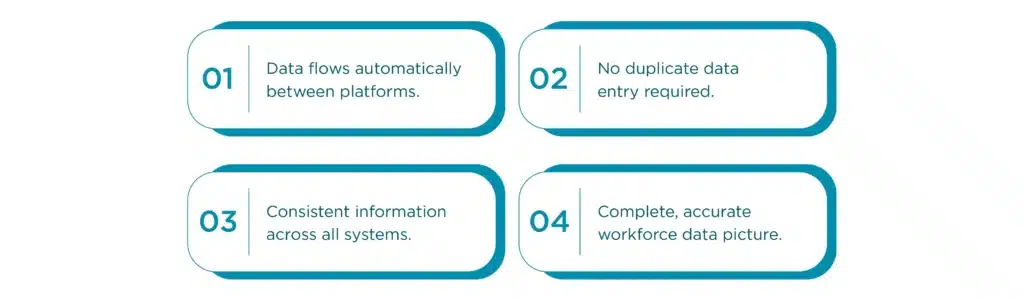
Payroll systems integration HR ERP benefits:
- Data flows automatically between platforms
- No duplicate data entry required
- Consistent information across all systems
- Complete, accurate workforce data picture
When an employee updates their address in HR, it updates in payroll. When they log overtime, it feeds directly into pay calculations. This connected approach eliminates duplicate data entry and ensures consistency.
How AI Actually Powers These Benefits
Understanding the technology behind AI in payroll helps demystify how these systems work. Rather than magic, it’s a combination of established technologies working together in sophisticated ways.
Each component plays a specific role in making payroll faster, more accurate and more insightful. Together, they create a system that’s genuinely smarter than traditional software.
Several technologies work together to deliver these advantages:
| Technology | What It Does? |
|---|---|
| Automated Data Handling | Pulls and validates information from multiple sources without manual intervention |
| Machine Learning | Learns from historical data to identify normal patterns and flag anomalies |
| Natural Language Processing | Powers chatbots that understand and answer employee questions |
| Predictive Analytics | Analyses trends to forecast costs, identify risks and suggest optimisations |
| Anomaly Detection | Continuously monitors transactions to spot unusual patterns indicating fraud or errors |
Regional Variations in the UK
Payroll isn’t uniform across Britain. Different regions face distinct challenges, from varying wage levels to different local employment patterns.
Smart payroll systems must account for these geographical differences while maintaining accuracy and compliance everywhere. This regional awareness is built into modern AI platforms.
According to ONS regional data, median pay across NUTS3 regions in November 2025 ranged significantly, with London as a whole showing a median monthly pay of £2,984.
This regional variation means that AI in payroll systems must be sophisticated enough to handle different pay scales, local regulations and regional employment patterns while maintaining accuracy across all locations.
Real-World Applications: How UK Businesses Are Using AI Payroll
Small Businesses
Small UK businesses benefit from AI payroll by gaining enterprise-level capabilities without needing a large payroll team. Automated validation, compliance monitoring and self-service features allow small businesses to:
- Process payroll accurately with minimal staff
- Compete with larger employers on employee experience
- Scale operations without proportionally increasing payroll costs
Medium-Sized Enterprises
For businesses with 50-500 employees, AI payroll systems help manage complexity:
- Handle multiple pay grades and salary structures
- Process variable payments like commission and bonuses
- Manage different employment types (full-time, part-time, contractors)
- Generate detailed reports for management
Large Organisations
Large enterprises use AI for advanced capabilities:
- Processing payroll for thousands of employees across multiple locations
- Managing complex compliance requirements
- Providing detailed workforce analytics
- Supporting strategic workforce planning
Cost Considerations
Cost savings from AI payroll automation accumulate over time. You’ll see immediate benefits in time saved, but the full financial impact including reduced errors, avoided penalties and strategic insights builds over months and years.
For businesses managing significant payroll volumes, the return on investment can be substantial when considering the reduction in manual processing time and error correction.
Popular UK AI Payroll Tools
When considering AI payroll implementation, several established UK providers offer comprehensive solutions:
- BrightPay: Popular among small businesses for its user-friendly interface and HMRC compliance
- PayFit: Cloud-based solution with strong automation features
- Staffology: Modern cloud payroll with excellent API integration
- Xero Payroll: Integrated solution for businesses already using Xero accounting
Each platform offers different strengths, so evaluate based on your business size, industry requirements and existing software ecosystem.
Industry-Specific Benefits
Different sectors face unique payroll challenges that AI systems are particularly well-suited to solve. From complex bonus structures in finance to variable shifts in hospitality, intelligent payroll adapts to industry needs.
Understanding how AI payroll works in your specific sector helps you appreciate the practical benefits you’ll experience day-to-day.
According to ONS sector data, median pay in September 2025 across sectors ranged from £1,380 in the accommodation and food service activities sector to £4,073 in finance and insurance.
Different sectors face unique payroll challenges:
- Finance and Insurance: Complex bonus structures and high-value transactions require sophisticated fraud detection
- Accommodation and Food Services: Variable hours and shift patterns demand flexible, automated time tracking
- Healthcare: Public sector pay rises and complex allowances need accurate, updated calculations
- Retail: Seasonal fluctuations require predictive analytics for workforce planning
AI payroll systems can adapt to these sector-specific needs while maintaining compliance across all industries.
The Future of AI in Payroll: What’s Coming Next
The payroll industry is evolving rapidly and several exciting developments are on the horizon:
Blockchain Integration
Some forward-thinking businesses are exploring blockchain payroll integration for:
- Immutable audit trails
- Enhanced security
- Transparent payment processing
- International payment simplification
Enhanced Predictive Analytics
Future systems will offer even more sophisticated payroll predictive analytics:
- Forecasting employee turnover with greater accuracy
- Predicting workforce cost trends
- Identifying optimal hiring times based on payroll patterns
- Supporting strategic HR planning
AI Chatbots for Employee Self-Service
AI chatbots for employee self-service payroll are becoming more sophisticated, offering:
- Natural language processing for more intuitive interactions
- Personalised financial advice
- Instant resolution of complex queries
- 24/7 support without human intervention
Global Multi-Currency Compliance
As UK businesses become more international, AI payroll tools for global multi-currency compliance will become essential, helping businesses:
- Manage payroll across multiple countries
- Handle currency conversions automatically
- Navigate different tax jurisdictions
- Ensure compliance with varied employment laws
How to Implement AI into Existing Payroll Systems
If you’re considering adding AI to your current payroll processes, here’s a practical approach:
1. Assess Your Current System
- Identify pain points and areas for improvement
- Review your existing software capabilities
- Determine which tasks consume the most time
- Calculate current error rates and costs
2. Define Your Goals
- What do you want AI to achieve? (e.g., reduce errors, speed processing, improve compliance)
- Set measurable targets (e.g., “reduce payroll processing time by 40%”)
- Determine your budget and timeline
3. Research Solutions
- Look for UK-focused systems with strong HMRC integration
- Check compatibility with your existing software
- Read reviews and case studies from similar businesses
- Request demonstrations from multiple providers
4. Start with a Pilot
- Test the system with a small group of employees first
- Monitor performance and gather feedback
- Make adjustments before full deployment
- Document lessons learned
5. Train Your Team
- Provide comprehensive training for all payroll staff
- Ensure team members understand both the technology and their oversight responsibilities
- Create clear procedures for handling edge cases
- Build confidence through hands-on practice
6. Monitor and Optimise
- Regularly review system performance
- Track key metrics (accuracy, processing time, employee satisfaction)
- Stay updated on new features and capabilities
- Continuously refine your processes
Frequently Asked Questions
Is payroll going to be automated completely?
No, while AI will automate many routine tasks, human expertise remains essential for complex cases, employee relations and ethical oversight. The future of payroll is a partnership between AI and skilled professionals.
Can payroll be done by AI?
AI can handle many payroll tasks, including data entry, calculations and compliance monitoring. However, it works best alongside human professionals who provide judgment, interpret complex situations and maintain employee relationships.
What is the future of AI in payroll?
AI will continue expanding its role in payroll through real-time processing, enhanced predictive analytics, better integration with HR systems and more sophisticated fraud detection. By 2030, AI will likely be standard in most payroll systems, but human oversight will remain crucial.
How does AI reduce manual errors in payroll processing?
AI reduces errors by automatically validating data, cross-checking information against patterns, flagging inconsistencies before processing and ensuring calculations follow the latest regulations without relying on manual updates.
Are AI payroll systems suitable for small businesses?
Yes, benefits of AI payroll systems for small businesses include enterprise-level capabilities at accessible prices, reduced need for large payroll teams and improved compliance without extensive legal knowledge. Many cloud-based solutions are specifically designed for smaller organisations.
How do I ensure GDPR-compliant payroll automation?
Choose systems that are specifically built for GDPR compliance, with features including data encryption, access controls, clear audit trails, employee consent management and data retention policies. Working with reputable UK-based payroll providers helps ensure compliance.
What are the cost savings from AI payroll automation?
Cost savings vary by organisation size but typically include: reduced labour costs (30-50% reduction in processing time), fewer error corrections (potentially thousands of pounds in avoided mistakes), lower compliance risks (avoiding HMRC penalties) and improved resource allocation.
How do payroll systems integrate with HR and ERP systems?
Modern automation payroll systems offer APIs and pre-built connectors for popular HR and ERP platforms. This allows automatic data syncing, eliminating duplicate entry and ensuring consistency across systems. Integration typically includes employee data, time and attendance, benefits and financial reporting.